 Lisa enjoying her Cretan lukamadas.
  The sheer cliff face of the Samaria Gorge, water-stained and beautiful.
 Nikos, myself, Alice, and Lisa in the bottom of the gorge.
 The Samaria Gorge.
 There were hundreds of these little ebeneezers stacked up along the hike in the gorge! I added mine to the collection.
The harbor view of the port city, Chania.
 The top view of Beta Theta- the trench extends all the way to the top of the frame.
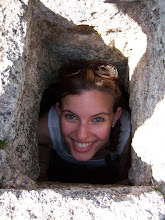
 My plaster-lined pit in Beta Theta.
 My roommates Alicia and Kelly and I- dressed in red, white, and blue at the Independence Day barbeque. Yay 'MERICA!
 The crowded Odeon at the performance of Don Quixote.
It’s difficult to believe that I’ve already been in Athens on the excavation for 4 weeks! I’ve made some wonderful friends, worked very hard, and explored many beautiful places so far, and all of it has happened in only one month. All of the diggers here believe that we live our lives on “Agora time”. Agora time simply means that although the days can sometimes drag on in the heat and strain of excavating, entire weeks seem to fly by, our experiences from week to week and weekend to weekend continually blur together, and the new relationships we’ve formed don’t seem new at all, but rather we feel as though we’ve known each other for many years. The past week and weekend proved to be perfect examples of Agora time (combined with some serendipitous moments of simple good timing).
This was the second week of my second rotation, which means I was still working in the trench called Beta Theta. As I explained in the last post, Beta Theta is not necessarily the most exciting trench when it comes to archaeological finds, but in the last week we have made great progress as far as clearing out a good deal of modern fill. This week I was mainly working in the western section of Beta Theta with my friend, Kat. A few weeks earlier, some diggers found the outline of a large rectangular pit that had been lined with plaster and was most likely used as a sort of garbage area. Starting this week, Kat and I were assigned to open this area (to start excavating in a new area and continue digging until we find a significant reason to stop, such as a change in the soil color, composition, or content) and dig down inside the plaster-lined walls. Although we were digging in the pit for almost an entire week, we were only able to make a few passes due to the size of the area (a pass is one even, horizontal sweep over an opened archaeological area, usually ranging from 3-10 cm in depth), and we were mainly digging in modern fill. We found a good amount of glazed Turkish and Byzantine pot sherds, and Kat found a nicely preserved fragment of a decorated Roman lamp. Digging in this area got a bit monotonous at times, but our supervisors were well aware of this so they assigned both Kat and I to “pottery washing” twice during the week.
Each trench typically sends 2-5 diggers per day to the pottery washing area where we have several tasks. The first task (you guessed it) is to wash the pieces of pottery that have been found in each area of a trench and keep careful track of those specific sherds. Once all the pieces from a given area have been washed, we sort them into four categories: diagnostic coarse ware, non-diagnostic coarse ware, diagnostic fine ware, and non-diagnostic fine ware. Basically, if a sherd has any glaze or paint at all, it’s considered fine ware, and if it doesn’t, it’s considered coarse ware. Similarly, if a sherd has a definite shape (such as a handle, a rim, or a base), and can be easily classified as a part of a specific type of vessel, it’s considered diagnostic, and if the sherd has only broken edges and is not any specific shape, it’s considered non-diagnostic. After we’ve sorted out the sherds into these 4 categories we lay them out on wire screens and count the number of each type of sherd and record it. Later in the day, the supervisors in each trench come to PW to sort through all the sherds and decide which pieces are important enough to save, and which pieces don’t tell them any new information about their respective trenches and can be discarded. Overall, PW duty entails a good deal of washing, sorting, and counting, but the area is in the shade and the water used for washing is cool, so especially on hot days, getting sent to PW is a welcome reprieve from digging in the sun. The weather all week in Athens was bordering on 100 degrees, so needless to say, Kat and I didn’t mind pottery washing duty twice this week.
As always, my free time this week/weekend was consumed by some super fun activities! We had several group dinners and I had an unexpected visitor. On Thursday I had ventured up to the Stoa of Attolos (where the diggers gather in the morning and afternoon) to fetch water for everyone. I was on my way out of the Agora proper and headed back to my trench when I heard someone call out my name, and who should I see but my friend from Concordia, Megan Dowd! It turns out that she was in Athens on vacation with her family, and she was out exploring with her brother near the Agora when she just happened to look up and see me walking by! I took the two of them around our trenches and gave them the grand tour, and later I was able to hang out with Megan and chat about home and past adventures. It was so nice to see another friend in Athens! I most definitely appreciated the serendipitous timing of our random meeting on the street in Athens- thousands of miles from Fargo-Moorhead, where we last saw each other!
One night, Katie, Lindsey, Caroline, and I went to a play in the Odeon of Herodus Atticus (at the base of the Akropolis). The play was Don Quixote, and unfortunately it was all in modern Greek- but we knew that initially so we were prepared for a language barrier. It was incredible to see the Odeon filled with thousands of people and to watch the play in the same manner as the ancient Romans would have! The play did use lights and microphones, but other than those technological aids the show was very true to the history of the venue. The set and costumes were impressive but simple, and it was easy to imagine that we were watching a play in the same place that thousands of Romans and Greeks watched plays so many hundreds of years ago.
To celebrate Independence Day, we had a big potluck/barbeque in the garden of the American School on Wednesday (which was technically Canada Day, as our Canadian digger, Kirsten, pointed out). We had some of our favorite American foods, listened to Classic Rock, played soccer, and celebrated with each other and the many international diggers from Canada, Australia, Italy, Greece, Britain, Norway, and Sweden. It was certainly the most diverse Independence Day party I’ve ever experienced! Also in honor of Independence Day, we were given a 3-day weekend. The timing of the weekend could not have been better- we were all getting exhausted from digging and needed a break from the trenches and the city. Everyone used the long weekend to travel to their favorite far corners of Greece. One group spent their vacation in Rhodes, one group spent it in Naxos, one group traveled around the Peloponnese, and the group I traveled with went to Crete for 3 days.
There were about 10 people who traveled to and from Crete together on the overnight ferries, but we all split up when we arrived at the island. I spent the weekend with my friends Alice and Lisa and our Couchsurfing host, Nikos. On July 4th, we docked in Iraklio (the biggest city in Crete) and took a bus directly to Chania, which is my favorite port city on the island. Nikos picked us up from the bus station and guided us around the shops and shoreline of the city for the day, and then he took us to a beautiful beach where a freshwater river collided with the sea. That night, we had dinner with Nikos and his friends- we ate a chicken (that the guys butchered for us!) and some traditional Cretan foods such as rice soaked in chicken stock and Greek salad. It was an unconventional Independence Day, to say the least, but it was very enjoyable. The next day, we took a bus from Chania to the top of the Samaria Gorge and hiked the 19 kilometers (about 12 miles) to the bottom. It was such a beautiful place, and I’ve wanted to hike there for over a year. The gorge is one of the largest in Europe- in some places its walls are 500 meters high and in other places the walls are only 3 meters apart! It was absolutely breathtaking and was like nothing I’ve ever seen, not even in the spectacular Rocky Mountains of Glacier National Park. I have to admit, however, that hiking in the gorge made me very Montana-sick! The hike brought us out at the southern coast of Crete and we were able to spend the rest of the afternoon on a black rock beach. It was an amazing day! On our last day in Crete we said goodbye to Nikos, who was an amazing host, and headed to Iraklio. We spent a while at the ruins of the Minoan palace of Knossos and then went to the Archaeological Museum of Iraklio (which was unfortunately still undergoing renovations, so the collections were pretty limited). We spent our last few hours exploring the city and hunting out my favorite lukamada shop (Greek donuts that are deep fried and then soaked in a delicious honey and cinnamon sauce…mmm…tasty). Alice and Lisa enjoyed them just as much as I hoped they would! We then boarded the boat, met up with the rest of the diggers who had had their own Cretan adventures, and prepared for our 9 hour journey home. We arrived in Athens at 6 am and were back in the trenches by 7:00! It was quite the whirlwind trip, but it was an amazing 3 day weekend!
In this last week, the timing of my pottery washing duty, Megan’s visit, and the 3-day weekend was absolutely perfect. After having a break in Crete, I feel totally rejuvenated and ready to finish the last half of the dig with the same energy that I started with one month ago. I also feel the last pangs of homesickness subsiding (thanks in part to Megan’s visit), which will help me to further enjoy the next 4 weeks in Athens with the other diggers. I often think of home, family, and friends, but now I am finally starting to think of Athens as my home-away-from-home. I know the next month will go by just as quickly as the first (especially with the aid of Agora time), and I plan to make the most of the time I have left on this wonderful adventure!
This was the second week of my second rotation, which means I was still working in the trench called Beta Theta. As I explained in the last post, Beta Theta is not necessarily the most exciting trench when it comes to archaeological finds, but in the last week we have made great progress as far as clearing out a good deal of modern fill. This week I was mainly working in the western section of Beta Theta with my friend, Kat. A few weeks earlier, some diggers found the outline of a large rectangular pit that had been lined with plaster and was most likely used as a sort of garbage area. Starting this week, Kat and I were assigned to open this area (to start excavating in a new area and continue digging until we find a significant reason to stop, such as a change in the soil color, composition, or content) and dig down inside the plaster-lined walls. Although we were digging in the pit for almost an entire week, we were only able to make a few passes due to the size of the area (a pass is one even, horizontal sweep over an opened archaeological area, usually ranging from 3-10 cm in depth), and we were mainly digging in modern fill. We found a good amount of glazed Turkish and Byzantine pot sherds, and Kat found a nicely preserved fragment of a decorated Roman lamp. Digging in this area got a bit monotonous at times, but our supervisors were well aware of this so they assigned both Kat and I to “pottery washing” twice during the week.
Each trench typically sends 2-5 diggers per day to the pottery washing area where we have several tasks. The first task (you guessed it) is to wash the pieces of pottery that have been found in each area of a trench and keep careful track of those specific sherds. Once all the pieces from a given area have been washed, we sort them into four categories: diagnostic coarse ware, non-diagnostic coarse ware, diagnostic fine ware, and non-diagnostic fine ware. Basically, if a sherd has any glaze or paint at all, it’s considered fine ware, and if it doesn’t, it’s considered coarse ware. Similarly, if a sherd has a definite shape (such as a handle, a rim, or a base), and can be easily classified as a part of a specific type of vessel, it’s considered diagnostic, and if the sherd has only broken edges and is not any specific shape, it’s considered non-diagnostic. After we’ve sorted out the sherds into these 4 categories we lay them out on wire screens and count the number of each type of sherd and record it. Later in the day, the supervisors in each trench come to PW to sort through all the sherds and decide which pieces are important enough to save, and which pieces don’t tell them any new information about their respective trenches and can be discarded. Overall, PW duty entails a good deal of washing, sorting, and counting, but the area is in the shade and the water used for washing is cool, so especially on hot days, getting sent to PW is a welcome reprieve from digging in the sun. The weather all week in Athens was bordering on 100 degrees, so needless to say, Kat and I didn’t mind pottery washing duty twice this week.
As always, my free time this week/weekend was consumed by some super fun activities! We had several group dinners and I had an unexpected visitor. On Thursday I had ventured up to the Stoa of Attolos (where the diggers gather in the morning and afternoon) to fetch water for everyone. I was on my way out of the Agora proper and headed back to my trench when I heard someone call out my name, and who should I see but my friend from Concordia, Megan Dowd! It turns out that she was in Athens on vacation with her family, and she was out exploring with her brother near the Agora when she just happened to look up and see me walking by! I took the two of them around our trenches and gave them the grand tour, and later I was able to hang out with Megan and chat about home and past adventures. It was so nice to see another friend in Athens! I most definitely appreciated the serendipitous timing of our random meeting on the street in Athens- thousands of miles from Fargo-Moorhead, where we last saw each other!
One night, Katie, Lindsey, Caroline, and I went to a play in the Odeon of Herodus Atticus (at the base of the Akropolis). The play was Don Quixote, and unfortunately it was all in modern Greek- but we knew that initially so we were prepared for a language barrier. It was incredible to see the Odeon filled with thousands of people and to watch the play in the same manner as the ancient Romans would have! The play did use lights and microphones, but other than those technological aids the show was very true to the history of the venue. The set and costumes were impressive but simple, and it was easy to imagine that we were watching a play in the same place that thousands of Romans and Greeks watched plays so many hundreds of years ago.
To celebrate Independence Day, we had a big potluck/barbeque in the garden of the American School on Wednesday (which was technically Canada Day, as our Canadian digger, Kirsten, pointed out). We had some of our favorite American foods, listened to Classic Rock, played soccer, and celebrated with each other and the many international diggers from Canada, Australia, Italy, Greece, Britain, Norway, and Sweden. It was certainly the most diverse Independence Day party I’ve ever experienced! Also in honor of Independence Day, we were given a 3-day weekend. The timing of the weekend could not have been better- we were all getting exhausted from digging and needed a break from the trenches and the city. Everyone used the long weekend to travel to their favorite far corners of Greece. One group spent their vacation in Rhodes, one group spent it in Naxos, one group traveled around the Peloponnese, and the group I traveled with went to Crete for 3 days.
There were about 10 people who traveled to and from Crete together on the overnight ferries, but we all split up when we arrived at the island. I spent the weekend with my friends Alice and Lisa and our Couchsurfing host, Nikos. On July 4th, we docked in Iraklio (the biggest city in Crete) and took a bus directly to Chania, which is my favorite port city on the island. Nikos picked us up from the bus station and guided us around the shops and shoreline of the city for the day, and then he took us to a beautiful beach where a freshwater river collided with the sea. That night, we had dinner with Nikos and his friends- we ate a chicken (that the guys butchered for us!) and some traditional Cretan foods such as rice soaked in chicken stock and Greek salad. It was an unconventional Independence Day, to say the least, but it was very enjoyable. The next day, we took a bus from Chania to the top of the Samaria Gorge and hiked the 19 kilometers (about 12 miles) to the bottom. It was such a beautiful place, and I’ve wanted to hike there for over a year. The gorge is one of the largest in Europe- in some places its walls are 500 meters high and in other places the walls are only 3 meters apart! It was absolutely breathtaking and was like nothing I’ve ever seen, not even in the spectacular Rocky Mountains of Glacier National Park. I have to admit, however, that hiking in the gorge made me very Montana-sick! The hike brought us out at the southern coast of Crete and we were able to spend the rest of the afternoon on a black rock beach. It was an amazing day! On our last day in Crete we said goodbye to Nikos, who was an amazing host, and headed to Iraklio. We spent a while at the ruins of the Minoan palace of Knossos and then went to the Archaeological Museum of Iraklio (which was unfortunately still undergoing renovations, so the collections were pretty limited). We spent our last few hours exploring the city and hunting out my favorite lukamada shop (Greek donuts that are deep fried and then soaked in a delicious honey and cinnamon sauce…mmm…tasty). Alice and Lisa enjoyed them just as much as I hoped they would! We then boarded the boat, met up with the rest of the diggers who had had their own Cretan adventures, and prepared for our 9 hour journey home. We arrived in Athens at 6 am and were back in the trenches by 7:00! It was quite the whirlwind trip, but it was an amazing 3 day weekend!
In this last week, the timing of my pottery washing duty, Megan’s visit, and the 3-day weekend was absolutely perfect. After having a break in Crete, I feel totally rejuvenated and ready to finish the last half of the dig with the same energy that I started with one month ago. I also feel the last pangs of homesickness subsiding (thanks in part to Megan’s visit), which will help me to further enjoy the next 4 weeks in Athens with the other diggers. I often think of home, family, and friends, but now I am finally starting to think of Athens as my home-away-from-home. I know the next month will go by just as quickly as the first (especially with the aid of Agora time), and I plan to make the most of the time I have left on this wonderful adventure!

From thousands of feet to few on seashore of Libya, Crete’s Samaria George happens to be attractive, crude & adventurous trek on land of ancient civilization of Greece. By the time of the break comes, there is a worthy visit to 14th century old chapel of Osia Maria, origin of Samaria George. Its nature offers a delight of 450 rare vegetations & wonderful wild life, which includes famous natural goats; kri-kri. To know more, refer: http://www.journeyidea.com/braving-the-majestic-samaria-gorge-part-i/
ReplyDelete